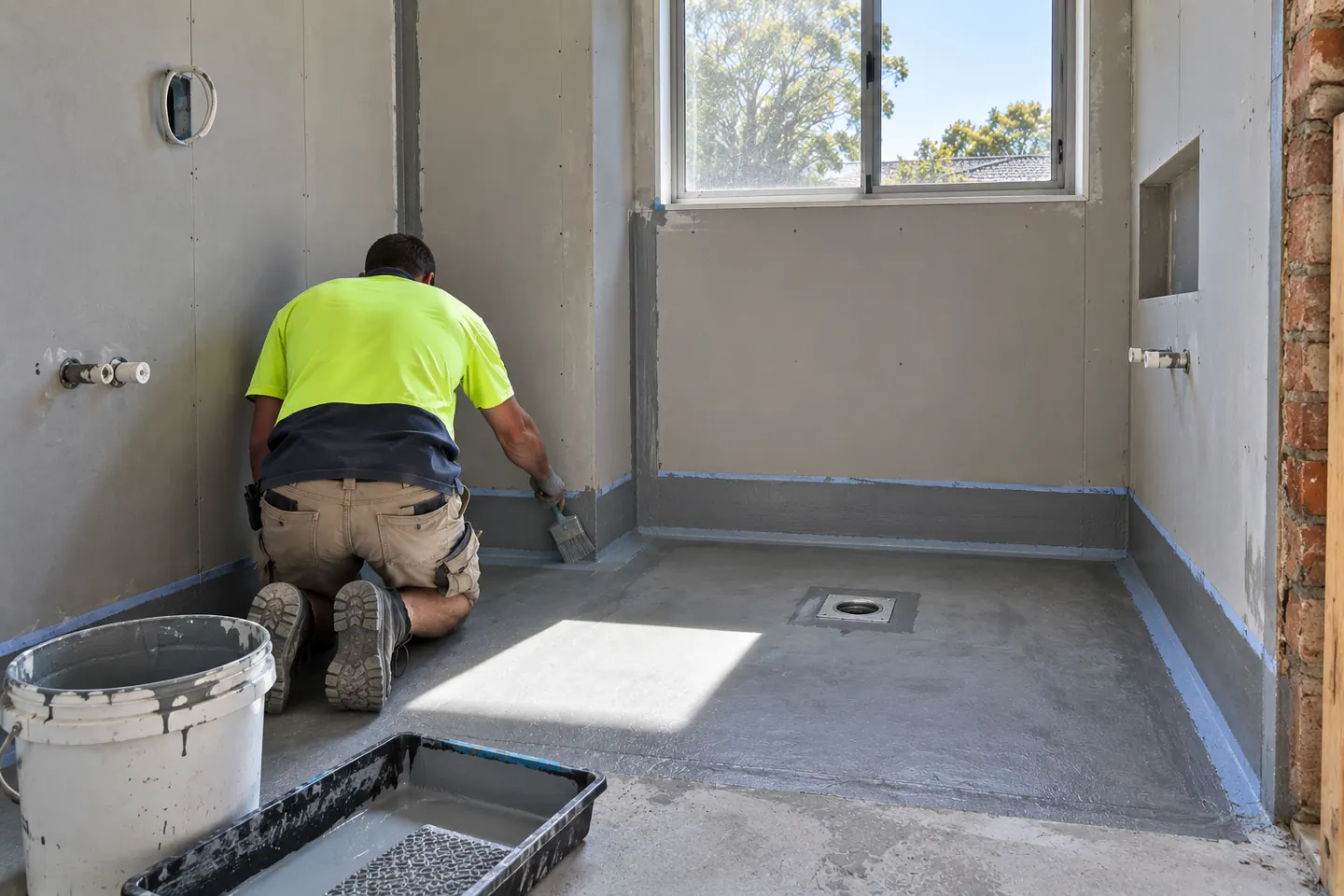
Why older Penrith showers leak
A lot of Penrith bathrooms built in the 1970s and 1980s were tiled over fibro or early wet-area board with little or no membrane, relying on the tiles and grout to keep water in. Showers from the 1990s often had a membrane, but only in the shower recess, and thirty years of expansion, movement and cleaning products have taken their toll.
The usual failure points:
- The hob — water gets under it and wicks into the wall frame
- The corner junctions — rigid grout cracks, and water follows the crack
- The waste — if the membrane was not properly dressed into the waste, water leaks around it
- The shower screen — fixings drilled through tiles without sealing
- Failed silicone at the floor-to-wall joint
On a concrete slab, water tends to spread under tiles and into adjoining rooms, lifting carpet or timber flooring. On a timber subfloor, it rots the sheeting and joists.
What a proper membrane involves
Waterproofing for wet areas is covered by an Australian Standard. In a renovation arranged through this site, the membrane stage typically includes:
- Substrate preparation — sound sheeting on walls, a clean slab or suitable floor sheeting, and a screed to form falls
- Priming the surfaces so the membrane bonds
- Bond breakers at internal corners and wall-to-floor junctions, so the membrane can flex instead of tearing
- Puddle flanges at every floor waste
- Membrane coats applied at the specified thickness, with drying time between
- A water stop at the bathroom doorway
- Inspection before tiling, and a certificate
The whole floor is waterproofed, not just the shower. Shower walls are membraned to the required height.
Heat and movement
Penrith's hot summers and cold winter mornings mean building materials expand and contract more than on the coast. Tiles, adhesive, grout and the membrane all move slightly with temperature. That is why flexible sealant goes in corners and at floor junctions instead of grout, and why bond breakers at junctions matter. A rigid, cracked corner is where most leaks begin.
It also affects the job itself. Membranes and adhesives behave differently in very hot or cold conditions, so the program allows for curing time rather than rushing to tile.
Falls and ponding
A membrane handles water that gets past the tiles. The tiles and falls handle the rest. If water ponds on a shower floor, it eventually finds a way through.
A walk-in shower without a hob needs the floor set down or built up so it falls to the waste. A linear drain along one wall allows a single fall and suits large tiles. A centre waste with a four-way fall suits smaller tiles and mosaics. See bathroom tiling.
Newer homes and statutory warranty
If your home was built in the last few years — in Jordan Springs, Caddens or a newer part of Glenmore Park — and a shower is leaking, check whether it is still within the builder's statutory warranty. In NSW, major defects are covered for six years and other defects for two years from completion. Waterproofing failures that cause water damage can be significant, so raise it with the builder in writing before paying for repairs.
Signs you should not ignore
- A tile that sounds hollow when tapped near the shower
- Grout or silicone that keeps going mouldy or cracking
- A skirting board or door frame outside the bathroom that has swollen
- Carpet or floating floors that lift near the bathroom wall
- A musty smell that returns after cleaning
Early investigation is cheaper than a new subfloor.
Ventilation helps too
Moisture that stays in the air ends up in the ceiling and walls. A ducted exhaust fan with a timer is part of keeping a bathroom dry and is included in every renovation we price.
Licensing and payment
Waterproofing is part of residential building work. Renovation work arranged through this site is carried out in partnership with Coastal Renovation Group, a licensed NSW builder; licence and insurance details are provided on request. The deposit on residential building work in NSW is capped at 10 per cent, and for work over $20,000 home building compensation cover must be in place before a deposit is requested.
See the main bathroom page for the full renovation. Call 02 4703 9332 or send the room details through.
Get a firm price
- PhotosTwo or three angles of the room.
- SizeRough length and width.
- Wish listShower, bath, vanity, storage.
Questions people ask before they commit
How do I know if my shower is leaking?
Common signs are loose or drummy tiles near the shower, grout that keeps cracking, swollen skirting or door frames outside the bathroom, a musty smell, and damp or lifting flooring in the next room. On a slab, water can travel some distance before it shows.
Can a leaking shower be fixed without a full renovation?
Sometimes. If the problem is failed grout or silicone and the membrane underneath is sound, regrouting and resealing can work. If water is getting past the membrane, or there never was one, the tiles have to come up to fix it properly.
What does waterproofing cost?
In a full renovation, the preparation and membrane for a typical bathroom are usually a few thousand dollars of the total. Shower-only re-waterproofing, with tiles removed and replaced in the shower area, is often $4,000 to $8,000 as a 2026 guide.
Will I get a certificate?
Yes. A waterproofing certificate is issued once the membrane is complete. Keep it — buyers, insurers and strata managers may ask for it.